

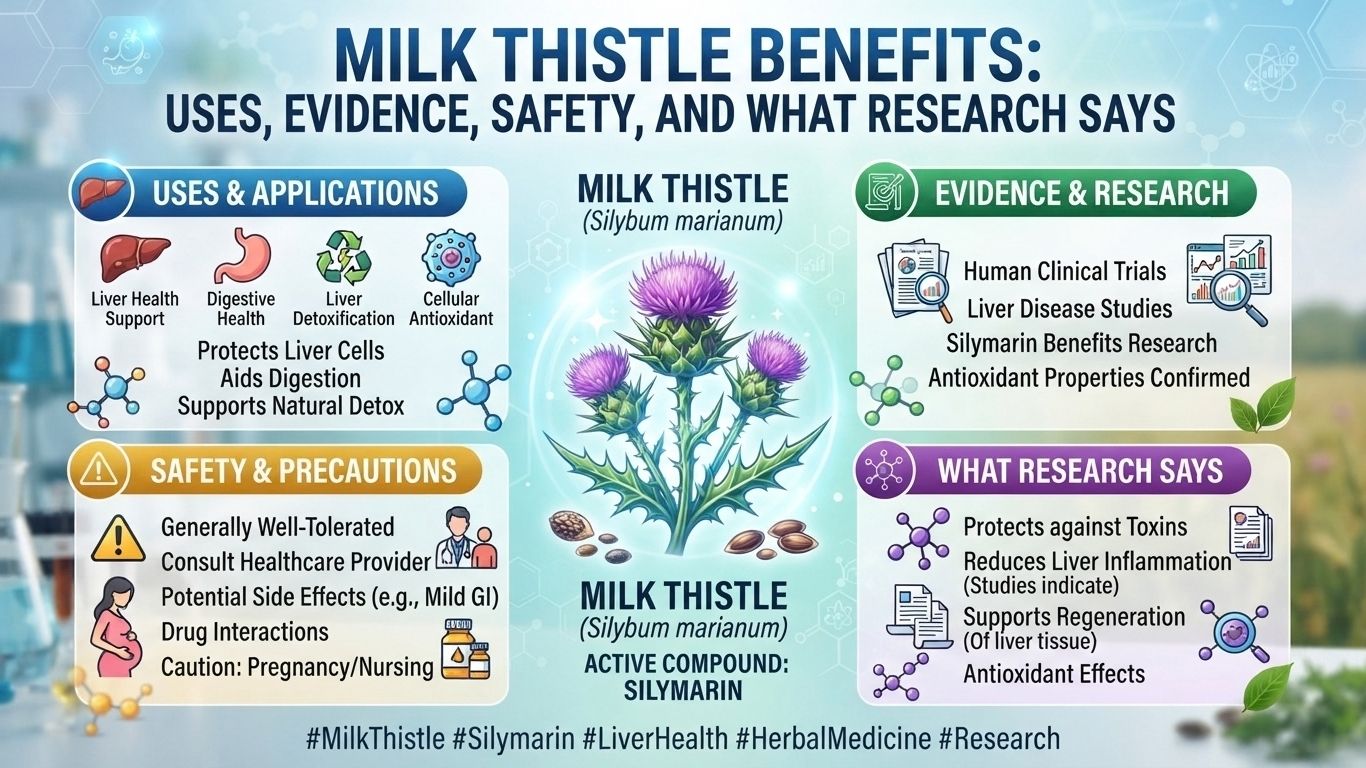
Milk thistle benefits are most often associated with liver health, blood sugar control, and the antioxidant properties of its main active compounds. However, research in humans has not established milk thistle as an effective treatment for most health conditions. Its main compound, silymarin, has been studied extensively, particularly for liver diseases, but results have been mixed. Some studies suggest possible metabolic benefits, while others have found little or no meaningful clinical improvement.
What Is Milk Thistle?
Milk thistle is a flowering plant traditionally associated with liver health, and its most studied component is a group of compounds called silymarin.
Milk thistle, scientifically known as Silybum marianum, is a tall plant with distinctive purple flowers that originated in Europe and was later introduced to North America. It has a long history of traditional use for liver-related conditions and other purposes. Today, milk thistle is commonly sold as a dietary supplement in capsules, tablets, powders, and extracts.
The term silymarin refers to a mixture of compounds extracted from milk thistle. Researchers have focused much of their attention on silymarin because laboratory studies have identified antioxidant and anti-inflammatory activity associated with some of its components. However, effects observed in laboratory experiments do not automatically translate into proven health benefits in people.
This distinction is particularly important with herbal supplements. A product may have interesting biological properties without being proven to prevent, treat, or cure a disease.
What Are the Main Milk Thistle Benefits?
The most researched potential milk thistle benefits involve liver health and blood sugar, but the available evidence is not strong enough to confirm most claimed effects.
Milk thistle is frequently marketed for several potential uses. These include supporting the liver, protecting cells from oxidative stress, helping regulate blood sugar, and supporting people with certain liver conditions. Research has investigated these claims to varying degrees, but the results are not consistent.
1. Liver Health
Liver health is the most widely studied area of milk thistle research, although clinical trials have produced conflicting results.
Because silymarin has antioxidant and other biological effects in laboratory studies, researchers have investigated whether it can help people with liver diseases. Clinical studies have examined milk thistle in conditions including hepatitis B and C, alcohol-related liver disease, non-alcoholic fatty liver disease, and liver problems associated with certain treatments or toxins.
The results have generally been inconsistent. According to the National Center for Complementary and Integrative Health (NCCIH), the evidence is currently too limited or conflicting to establish that milk thistle improves liver disease. Two NCCIH-supported studies involving hepatitis C and non-alcoholic steatohepatitis did not demonstrate benefits from silymarin supplementation.
Therefore, milk thistle should not be considered a proven treatment for liver disease.
2. Possible Blood Sugar Effects
Some human studies suggest milk thistle may influence blood sugar levels, but the evidence remains limited.
Research has investigated milk thistle extracts in people with type 2 diabetes. NCCIH reports that a small number of studies have suggested possible improvements in blood sugar control. However, much of this research was conducted in Middle Eastern countries, and it remains uncertain whether the same findings would apply broadly to other populations.
Research limitations include relatively small studies and differences in the preparations and doses used. More rigorous research is needed before milk thistle can be considered an established approach for managing diabetes.
People with diabetes should also avoid replacing prescribed treatment with an herbal supplement.
3. Antioxidant Activity
Silymarin has demonstrated antioxidant activity in laboratory research, but this does not prove a corresponding health benefit in people.
Antioxidants are substances that can help counter oxidative processes involving unstable molecules known as free radicals. Laboratory research has found that silymarin can influence oxidative and inflammatory pathways. These findings have helped explain why milk thistle has attracted scientific interest.
However, laboratory findings should not be confused with clinical evidence. A biological effect in cells or experimental models does not necessarily mean that taking a supplement will prevent disease or improve health in humans.
4. Possible Anti-Inflammatory Effects
Laboratory research suggests that silymarin can influence inflammatory signaling, but its clinical significance remains uncertain.
Researchers have observed changes in cellular pathways involved in inflammation after exposure to silymarin. One study supported by NCCIH investigated how silymarin affected cellular stress and inflammatory signaling and identified a complex, two-phase cellular response.
These findings are useful for understanding how the compound might work biologically, but they are not evidence that milk thistle supplements treat inflammatory diseases in humans.
5. Traditional Digestive and General Health Uses
Milk thistle has been traditionally used for several health purposes, but many traditional uses have not been confirmed by modern clinical research.
Historically, milk thistle was used for liver disorders and was also associated with attempts to increase breast milk production. Modern research has not established that milk thistle reliably increases breast milk production, and evidence for many other proposed uses remains insufficient.
Traditional use can provide useful clues for researchers, but it is not equivalent to evidence from well-designed clinical trials.
How Does Milk Thistle Work?

Milk thistle’s proposed effects are primarily linked to silymarin, a mixture of plant compounds that can influence several cellular processes.
Scientists have studied silymarin because laboratory experiments suggest that it can affect oxidative stress, inflammatory signaling, cellular metabolism, and other biological pathways. These mechanisms have led researchers to investigate whether milk thistle could have therapeutic applications.
The challenge is that laboratory activity does not necessarily translate into measurable improvements in patients. The amount absorbed by the body, the specific formulation used, the dose, and the underlying health condition can all affect results.
This is one reason different studies of milk thistle can produce different findings even when they appear to investigate similar questions.
Does Milk Thistle Really Detox the Liver?
Milk thistle is often described as a liver “detox,” but there is not enough clinical evidence to support that claim.
The liver naturally performs complex processes that help metabolize drugs, alcohol, hormones, and other substances. Although milk thistle has been studied for liver-related conditions, current evidence does not establish that taking a milk thistle supplement “detoxes” the liver in healthy people.
Similarly, an herbal supplement should not be viewed as a way to cancel out heavy alcohol consumption, an unhealthy diet, or exposure to substances that can damage the liver.
People with abnormal liver tests or symptoms of liver disease should seek appropriate medical evaluation rather than relying on a detox supplement.
Milk Thistle and Hepatitis C
Clinical research has not shown milk thistle to be an effective treatment for hepatitis C.
Silymarin has been studied extensively in people with hepatitis C because of its proposed liver-protective effects. However, an evaluation of five studies involving 389 participants found no meaningful benefit in liver function or hepatitis C virus levels. A separate controlled trial involving 154 people also found that higher-than-usual doses of silymarin were no better than placebo for improving a measure of liver function.
NCCIH currently states that no dietary supplement has been shown to be effective for hepatitis C and that milk thistle is not better than placebo as a treatment for the infection.
This is particularly important because hepatitis C has effective medical treatments, and supplements should not replace appropriate antiviral therapy.
Milk Thistle for Fatty Liver Disease
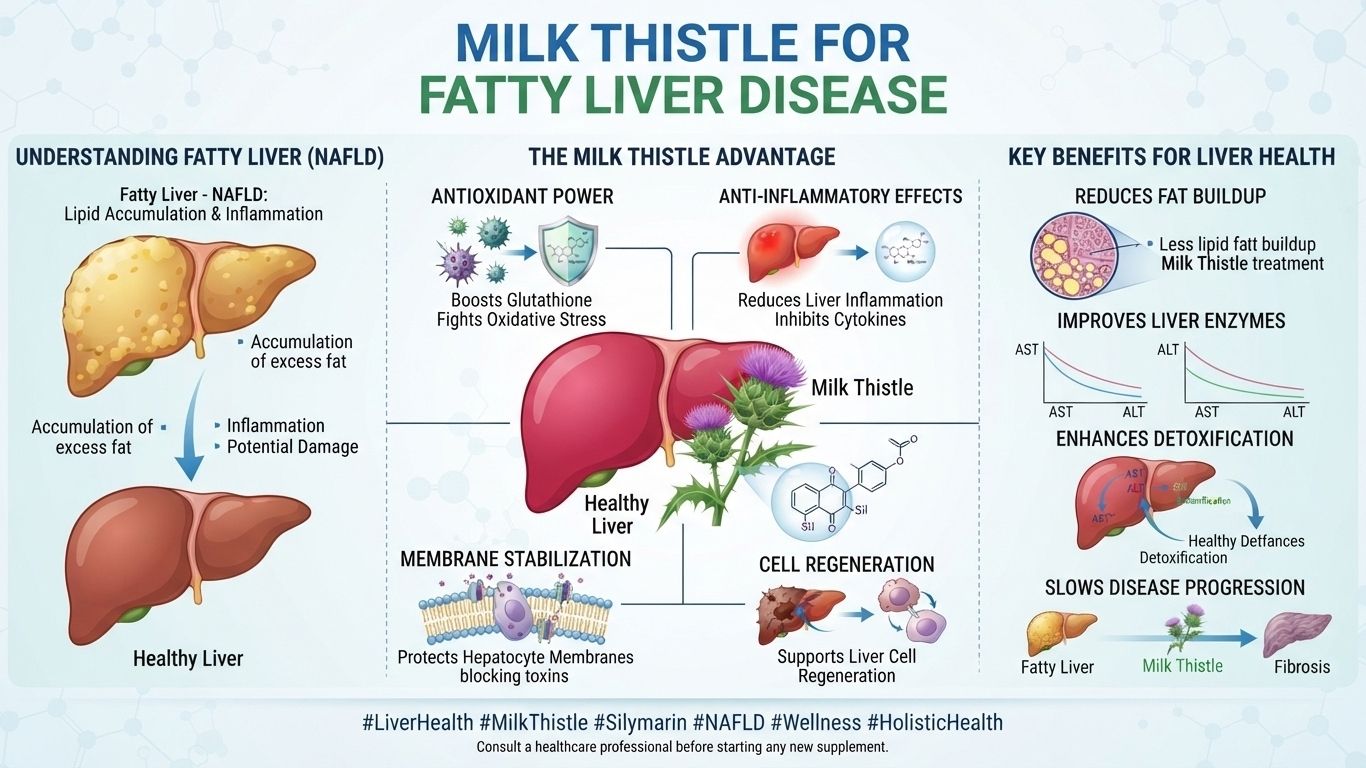
Research on milk thistle for fatty liver disease has produced insufficient evidence to establish a clear benefit.
Non-alcoholic fatty liver disease and related conditions have been studied in clinical trials of silymarin. Although some studies have reported changes in laboratory measurements, results have not consistently demonstrated meaningful improvements in disease outcomes.
NCCIH notes that a study of silymarin in non-alcoholic steatohepatitis, a progressive form of fatty liver disease, did not show a benefit from supplementation.
For people with fatty liver disease, management generally depends on the underlying cause and may involve weight management, physical activity, dietary changes, control of diabetes or cholesterol, and medical monitoring.
Is Milk Thistle Safe?
Milk thistle appears to be generally well tolerated when taken orally, but it can still cause side effects and may not be appropriate for everyone.
Reported side effects are usually mild digestive symptoms. These can include bloating, nausea, gas, diarrhea, abdominal discomfort, or a laxative effect. Allergic reactions are also possible, particularly in people who are sensitive to plants related to milk thistle.
As with other herbal supplements, product quality is another consideration. NCCIH has reported concerns about the chemical and microbiological quality of some commercially available milk thistle supplements. Some products may contain substantially different amounts of silymarin than their labels indicate or may contain contaminants.
“Natural” therefore does not automatically mean safe, standardized, or effective.
Can Milk Thistle Interact With Medications?
Milk thistle may interact with medications, so people who regularly take prescription or over-the-counter drugs should discuss supplementation with a healthcare professional.
Herbal supplements can affect how medicines work, although the extent of potential interactions can vary according to the specific product and medication. NCCIH recommends discussing milk thistle and other herbal products with a healthcare provider when medicines are being used.
Extra caution is appropriate for people taking multiple medications or managing chronic conditions. It is also useful to tell healthcare professionals about all supplements being taken because supplement use can otherwise be overlooked during medication reviews.
Who Should Be Careful With Milk Thistle?
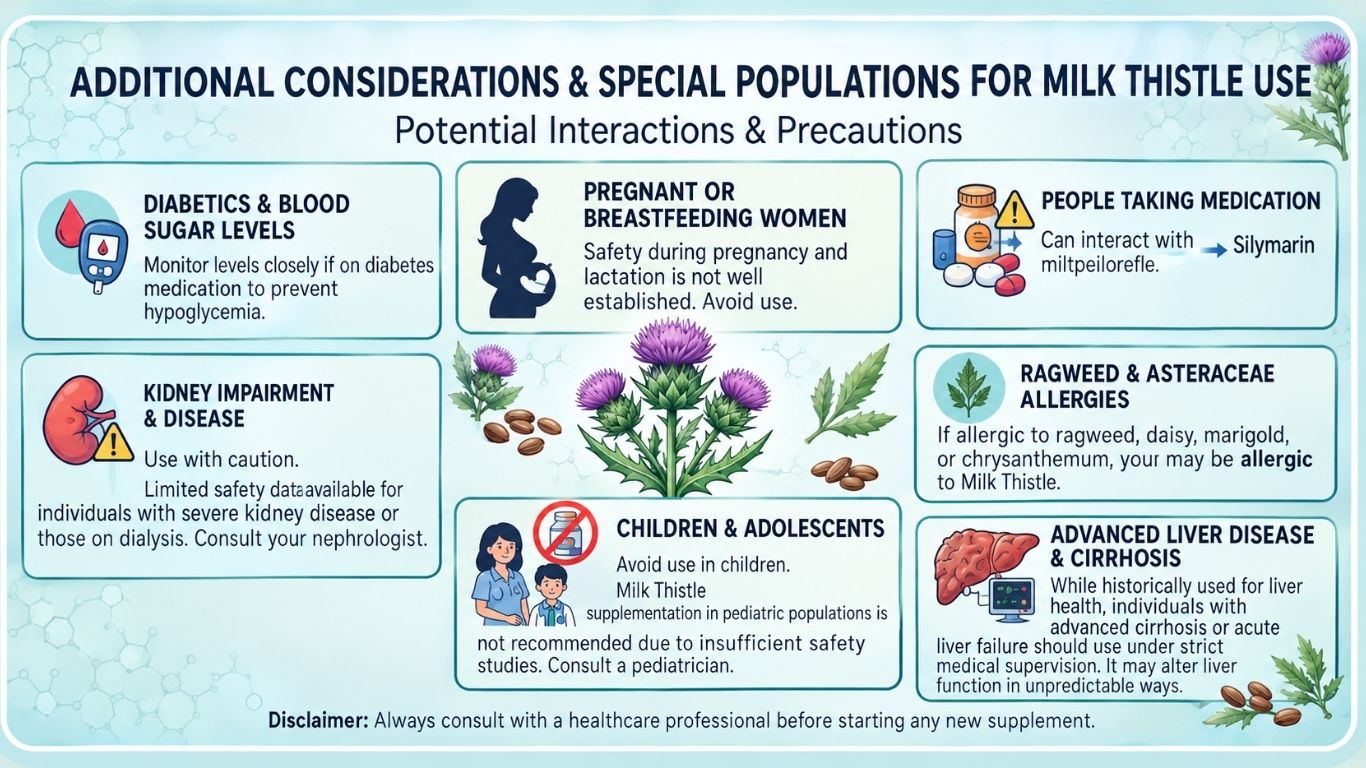
Certain people should discuss milk thistle with a healthcare professional before using it because safety and effectiveness are not equally established for every group.
People who are pregnant or breastfeeding should seek professional advice before taking milk thistle because there is limited information about its safety in these situations. NCCIH also advises particular caution when considering dietary supplements for children.
People with existing liver disease should also avoid assuming that a supplement is appropriate simply because it is marketed for liver health. The cause and severity of liver disease matter, and an unproven supplement should not delay diagnosis or treatment.
Anyone who develops unusual symptoms after starting a supplement should stop and seek appropriate medical guidance.
How Should You Choose a Milk Thistle Supplement?
Choosing a milk thistle supplement requires attention to the product’s ingredients, labeling, and quality because commercial preparations can vary considerably.
Research studies may use particular extracts or standardized preparations, while products sold to consumers can differ in their concentration and formulation. A supplement label may also use terms such as “standardized,” but this wording alone does not guarantee that a product will have a consistent composition or proven clinical benefit.
When considering a supplement, check the amount and form of the active ingredient listed on the label and avoid assuming that a higher amount will necessarily provide greater benefits. Because supplement quality can vary, discussing a specific product with a pharmacist or healthcare professional can be useful.
How Much Milk Thistle Should You Take?
There is no universally established dose of milk thistle that has been proven to provide general health benefits.
Clinical studies have used different amounts and formulations of silymarin, making it difficult to translate research findings into one standard recommendation for everyone. Some studies have also used doses that differ substantially from those found in ordinary commercial supplements.
For that reason, consumers should not assume that taking more milk thistle will produce greater health benefits. A healthcare professional can consider the person’s medical history, medications, and reason for using the supplement before discussing an appropriate product or dose.
Common Myths About Milk Thistle
Several popular claims about milk thistle go beyond what current human research can establish.
Myth: Milk Thistle Cleanses the Liver
There is insufficient evidence that milk thistle performs a general liver “cleanse” or removes toxins from the body. Its biological effects are being studied, but this is different from proving a detoxification benefit in healthy people.
Myth: Milk Thistle Treats Hepatitis C
Clinical evidence does not support milk thistle as a treatment for hepatitis C. Research has generally found no meaningful advantage over placebo, and established medical treatment should not be replaced with the supplement.
Myth: Natural Means Risk-Free
Milk thistle is generally well tolerated, but side effects, allergic reactions, medication interactions, and supplement-quality problems are possible.
Myth: Promising Laboratory Results Prove Health Benefits
Laboratory findings can help researchers understand potential mechanisms, but they do not prove that a supplement will prevent or treat a disease in humans. Clinical trials are needed to determine whether a biological effect translates into a meaningful health outcome.
What Does the Research Say Overall?
The overall evidence suggests that milk thistle is an interesting medicinal plant, but its commonly advertised health benefits remain incompletely established in humans.
The strongest research attention has focused on silymarin and liver conditions. Despite promising laboratory findings, clinical trials have produced inconsistent or limited results, and major studies have not demonstrated clear benefits for conditions such as hepatitis C.
There is also some preliminary evidence concerning blood sugar control in people with type 2 diabetes, but NCCIH describes the research as limited. More high-quality studies are needed to determine whether any observed changes are clinically meaningful and reproducible across different populations.
Consequently, milk thistle is best understood as a dietary supplement that is being researched for potential health effects rather than as a proven treatment for a specific disease.
Frequently Asked Questions About Milk Thistle Benefits
What is milk thistle mainly used for?
Milk thistle is most commonly used as a dietary supplement marketed for liver health. Its main studied compound is silymarin, which has been investigated for several liver conditions as well as blood sugar control.
Does milk thistle repair liver damage?
Current evidence does not establish that milk thistle repairs liver damage. Studies of liver diseases have produced conflicting or insufficient results, so it should not be considered a proven treatment for liver injury.
Can milk thistle lower blood sugar?
Some small studies suggest that milk thistle may help control blood sugar in people with type 2 diabetes, but the evidence is limited. It should not replace prescribed diabetes medication or other evidence-based management.
Does milk thistle help fatty liver?
Milk thistle has been studied for fatty liver disease, but the evidence is not strong enough to establish a clear benefit. One NCCIH-supported study of silymarin in non-alcoholic steatohepatitis did not show a benefit.
What are the common side effects of milk thistle?
The most commonly reported problems are digestive symptoms such as bloating, nausea, gas, diarrhea, or abdominal discomfort. Allergic reactions can also occur, particularly among people allergic to related plants.
Is milk thistle safe every day?
Milk thistle appears to be generally well tolerated when taken orally, but long-term use should not automatically be assumed to be appropriate for everyone. Product quality, medication interactions, allergies, pregnancy, breastfeeding, and existing medical conditions should all be considered.
Does milk thistle detox your body?
There is not enough clinical evidence to support the idea that milk thistle provides a general body or liver detox. The liver already performs its own metabolic and detoxification functions, and milk thistle should not be used as a substitute for addressing causes of liver injury.
Conclusion
The evidence behind milk thistle benefits is more limited than many supplement advertisements suggest. Silymarin, its primary studied compound, has demonstrated interesting antioxidant and cellular effects in laboratory research, while human studies have produced mixed findings, particularly for liver disease. Some research also suggests possible effects on blood sugar, but this evidence remains preliminary.
Milk thistle is generally well tolerated, but side effects, allergies, medication interactions, and differences in supplement quality should be considered. Readers interested in liver health may also want to learn about fatty liver disease, liver function tests, and evidence-based approaches to supporting liver health. Milk thistle should be viewed as a supplement under investigation rather than a proven cure or liver “detox.”